


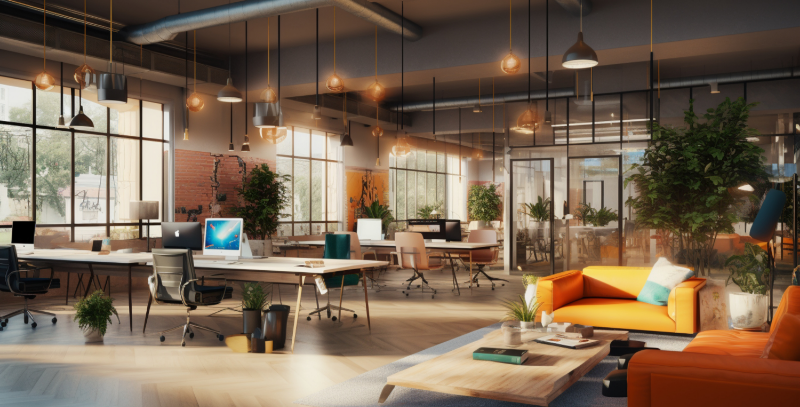
Urban co-working spaces succeed or fail on design decisions made before a single member walks through the door. In Singapore’s high-cost commercial property market, where CBD Grade A rents run S$10–16 per square foot monthly, getting spatial layout, material selection, and acoustic zoning right isn’t optional, it’s the difference between a productive workspace and an expensive liability.
 Why Industrial Design Works for Commercial Co-working Spaces
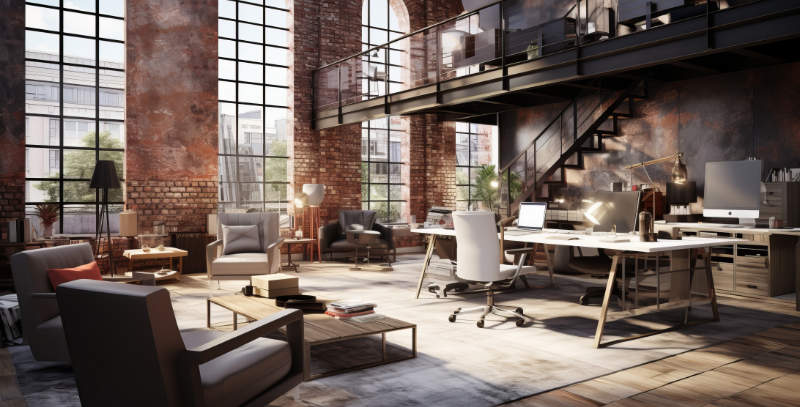
Industrial office design has moved well beyond its origins as a visual trend. In space-constrained urban markets, its core characteristics, open layouts, exposed structural elements, durable raw materials, function as a coherent operational philosophy.
An industrial aesthetic built around exposed concrete, steel framing, and timber surfaces naturally supports the open, reconfigurable layouts that co-working environments need. Leaving architectural features exposed (ductwork, ceiling beams, brick walls) reduces fit-out costs while maintaining a bold, intentional look. That cost efficiency matters to developers retrofitting older commercial buildings, which are common across Singapore’s CBD and fringe districts.
The flexibility argument is equally strong. Modular workstation systems that can be rearranged without structural changes are far better suited to a rotating membership base than fixed cellular configurations. Industrial design’s reliance on metal-framed furniture with solid wood tops, movable partitions, and open ceiling voids means operators can adapt layouts as demand shifts, without triggering a full renovation.
Spatial Layout: Getting the Zone Mix Right
The most consequential layout decision in co-working space design is how you distribute floor area across different zone types.
Traditional office layouts allocate 60–70% of floor area to individual workstations, with the remainder split between meeting rooms and support spaces. Activity-based working (ABW) redistributes that balance significantly. According to Help Corp’s analysis of Singapore office data, an ABW model typically allocates:
| Zone Type | ABW Allocation | Traditional Allocation |
| Individual work settings | 40–50% | 60–70% |
| Collaboration settings | 25–30% | 15–20% |
| Social / amenity areas | 10–15% | Minimal |
| Meeting / presentation | 10–15% | 15–20% |
| Support spaces | 5–10% | 10–15% |
ABW implementation typically reduces total space requirements by 15–30% while maintaining or improving member satisfaction. For co-working operators, this matters directly: a 10,000 sqft floor plate managed under ABW principles can support more members per square metre than a traditional fixed-desk layout, without degrading the experience.
Hot-desking within this model achieves desk-to-member ratios of 0.6–0.8:1, compared to the traditional 1:1. Effective execution requires a digital booking system, adequate personal storage (lockers, portable caddies), and enough variety in workspace types to accommodate peak attendance without crowding.
 Space Utilisation: What the Data Shows
Singapore office utilisation studies reveal that average occupancy across the workday sits at only 40–60%, with meeting rooms hitting 30–50% utilisation despite consuming 15–20% of total floor area (Help Corp). For co-working operators, this signals a clear opportunity: right-sizing the meeting room inventory and converting underused square footage into revenue-generating open desk or lounge areas.
Demand for flexible office solutions in Singapore grew 15% in 2024, driven by companies seeking to control space costs while maintaining collaboration capacity (Help Corp). This shifts the design brief for co-working spaces: members increasingly want variety, not just a desk.
 Acoustic Zoning: The Design Problem Most Operators Underestimate
Noise is consistently among the top complaints in shared offices. Open plan layouts that encourage collaboration create the same conditions that undermine focused work, and in a co-working environment serving members with different task demands simultaneously, this tension is amplified.
Effective acoustic design in co-working spaces requires more than adding panels after the fact. It needs to be integrated into the spatial layout from the outset.
Zone-Based Noise Planning
The starting framework is simple: divide the floor plate into distinct acoustic zones that match activity types.
- High-activity zones (reception, communal pantry, informal lounge, phone booths): positioned away from primary workstation areas, clustered together so noise sources don’t scatter across the floor
- Collaborative zones (project rooms, team tables, open meeting areas): mid-floor or near windows, with acoustic screens or hanging dividers defining boundaries without blocking natural light
- Focus zones (quiet desks, private pods, heads-down workstations): deepest into the floor plate, furthest from entry points and mechanical noise sources
Positioning the pantry and printing equipment in acoustically treated utility corners isolates mechanical noise, coffee machines, printers, and HVAC units contribute meaningfully to sound fatigue if left in open circulation areas.
 Material Choices for Acoustic Control
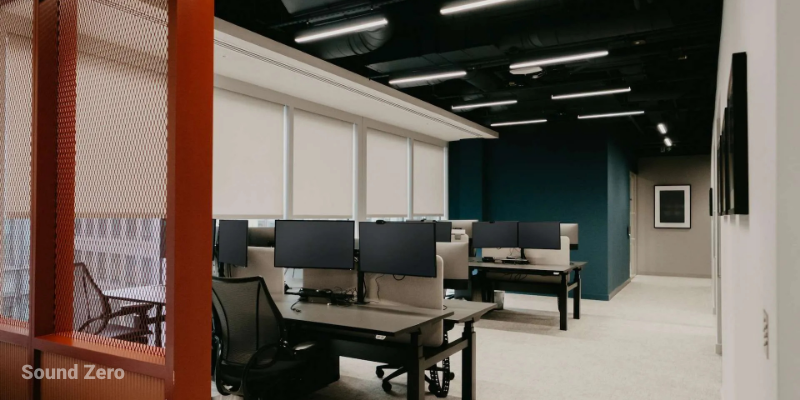
Hard surfaces boost noise; soft surfaces absorb it. In an industrial-aesthetic space built on concrete, steel, and glass, this creates a real tension that needs deliberate resolution.
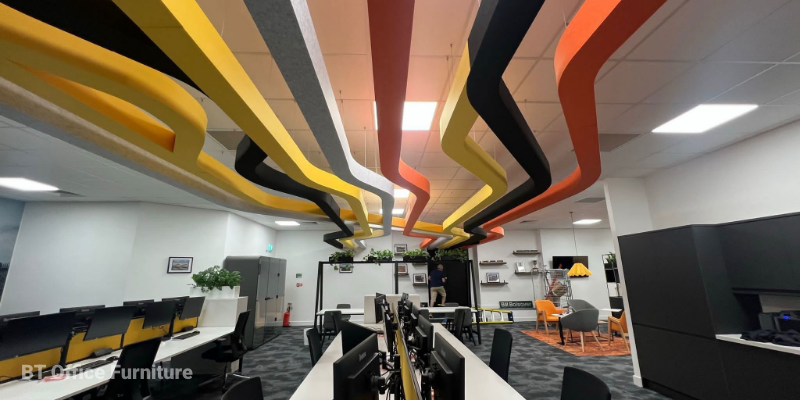
The answer lies in layering. Polyester fibre (PET) acoustic panels are a practical choice for Singapore co-working spaces, lightweight, available in a range of finishes, and capable of carrying custom graphics that integrate with a space’s brand identity. Ceiling baffles and acoustic clouds address sound at its source without interrupting sightlines.
Carpet tiles in quiet zones serve a dual purpose: they absorb mid-to-high-frequency sound while visually cueing members that this is a lower-noise area. That behavioural cue reduces the need for signage. Upholstered seating, fabric partitions, and timber slat ceilings with acoustic backing all contribute to breaking up sound paths in ways that complement rather than clash with an industrial material palette.
White noise or ambient sound systems add another layer. A consistent acoustic background, calibrated to mask random noise spikes without being noticeable itself, supports sustained focus across open desk areas where complete quiet isn’t achievable.
Enclosed Private Space: How Much Is Enough?
Cellular layouts offer acoustic separation and privacy that open areas can’t replicate. For co-working operators, the question is how much private office inventory to include. The answer depends on target membership: professional services, legal, and finance tenants expect enclosed offices or soundproofed phone booths as baseline provision, not a premium add-on.
A practical balance: reserve 15–25% of the floor plate for enclosed or semi-enclosed options (private offices, phone booths, small team rooms), with the remainder allocated to open and semi-open configurations. This avoids the footprint inefficiency of fully cellular layouts while meeting the needs of members who require confidentiality.
 Infrastructure and Technology: The Operational Layer
Design choices create the physical environment; infrastructure determines whether it works day-to-day.
Smart technology integration is now a baseline expectation in commercial co-working design. IoT occupancy sensors paired with booking systems give operators real-time visibility into which zones are actually being used, enabling layout adjustments based on evidence rather than assumption. Companies implementing integrated smart building systems report 15–25% reductions in energy consumption (Help Corp), which directly affects operational costs at scale.
Zone-based climate control and app-based booking systems serve members directly: they can adjust their immediate environment and reserve specific spaces without staff intervention. This reduces friction and improves satisfaction. Smart lighting that adjusts to occupancy and daylight levels handles another variable that affects comfort and energy spend simultaneously.
Cable management is a practical detail that often gets left until fit-out and then solved poorly. In open-plan industrial layouts, integrating cable management within metal desk frames and raised flooring keeps shared workstation areas functional and visually clean. Retrofitting cable solutions after furniture installation is more expensive and usually less effective.
As a general guide, Singapore CBD office fit-outs run S$120–200 per square foot in capital costs, typically amortised over 5–7 year lease terms, with furniture and equipment adding S$15,000–30,000 per employee position. Infrastructure investment in smart systems shifts some cost forward but reduces operational expenditure across the lease term.
Applying These Principles: A Design Checklist for Co-working Projects
Before finalising a co-working space design, review these decisions against the evidence:
- Zone mix: Does the floor plate allocate space across individual, collaborative, social, and enclosed zones, or default to predominantly open desks?
- Acoustic integration: Are noise sources (pantry, printers, HVAC) positioned away from focus zones? Is acoustic treatment built into the ceiling, floor, and partition strategy?
- Material layering: Does the material specification balance hard industrial surfaces with soft absorptive elements, or are aesthetics driving material choices at the expense of acoustic performance?
- Infrastructure readiness: Are occupancy sensors, booking systems, and cable management planned from the layout stage, not added after fit-out?
- Private space provision: Is enclosed inventory sized to match the expected membership profile, not just minimised to cut construction costs?
- Flexibility: Can the layout be reconfigured without structural works as membership needs evolve?
If your project is a co-working or flexible office environment, Adevo’s industrial commercial design for co-working spaces and co-working renovation guide cover how these principles translate into Singapore-specific design-build delivery.
Figures cited here are indicative and vary by project scope and site conditions, contact Adevo for a scoped assessment of your specific floor plate.
Frequently Asked Questions
What is the best layout for a co-working space?
An activity-based working layout distributing floor area across open desks, collaboration zones, focus areas, and enclosed private spaces typically outperforms single-mode layouts. The right balance depends on the target membership profile and floor plate size.
How do you control noise in an open plan co-working space?
Position noise sources like pantries and printers away from focus zones, install acoustic ceiling baffles and PET wall panels, and use carpet tiles in quiet areas to absorb sound and signal behaviour simultaneously.
How much space does a co-working member need in Singapore?
Singapore offices typically allocate 70–120 square feet per person depending on sector, but activity-based working and hot-desking can reduce this further while maintaining comfort through variety of setting types.
Is industrial design practical for co-working spaces or just aesthetic?
Industrial design is operationally well-suited to co-working: open layouts support reconfiguration, exposed structural elements reduce fit-out costs, and durable materials age better under high daily occupancy than more fragile finishes.
What technology should a co-working space integrate from day one?
IoT occupancy sensors, digital desk and room booking systems, zone-based climate control, and smart lighting should be planned at the layout stage, retrofitting these systems after fit-out costs more and performs less reliably.


