


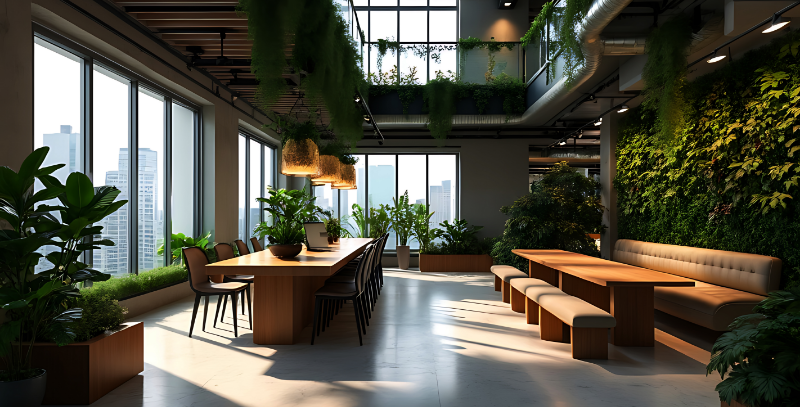
Lease renewal, a Green Mark pursuit, or a post-pandemic workplace upgrade, whichever brought you here, the stakes are real. Done well, biophilic design delivers measurable gains: 15% higher wellbeing scores, 6% productivity gains, and a stronger case for BCA Green Mark for Interiors (GMI) certification. Done poorly, you get dead plants and irrigation leaks within months.
At a Glance
| Field | Detail |
| Outcome | Certified biophilic office; measurable wellbeing gains |
| Time required | 16–18 weeks for full fit-out |
| Difficulty | Moderate, needs specialist coordination |
| Prerequisites | Budget, landlord approval, biophilic design team |
| Cost | +10–15% on base renovation cost |
What You’ll Achieve
You’ll end up with a Singapore office that integrates living plants, optimised natural light, organic materials, and nature-inspired patterns, delivering measurable wellbeing and productivity improvements while supporting GMI certification and Singapore Green Plan 2030 alignment. This guide is for office tenants planning fit-outs or renovations, triggered by lease renewal, a GMI pursuit, or a workplace strategy shift.
 Before You Start
Four prerequisites must be in place before Step 1. Missing any one of them stalls plant selection, waterproofing approvals, or certification submissions, and resequencing mid-fit-out is expensive. Get these confirmed in writing before design work begins.
- Base building conditions assessment, request M&E drawings and HVAC commissioning reports from building management; measure lux levels at workstation height (interior desks typically receive 50–100 lux) and confirm HVAC runs at 22–24°C, 40–60% RH year-round
- Budget line item for biophilic features, allocate 10–15% of total renovation cost; solicit three comparative quotes from horticultural installation specialists
- Interior designer with biophilic portfolio, review prior Singapore office projects; confirm the horticultural contractor has automated irrigation system warranties and a maintenance SLA track record
- Landlord written approval, submit a biophilic design intent letter with waterproofing and load calculations 8–12 weeks before fit-out starts; covers living wall fixings, waterproofing membranes, and HVAC load changes
- Green Mark Accredited Professional (GMAP), engage one if you’re pursuing GMI certification; they conduct the gap analysis and interface with SGBC’s GMI portal
 Step-by-Step: How to Implement Biophilic Design in Your Singapore Office
The process runs four phases, audit, design, certification pre-assessment, and installation, followed by ongoing maintenance. Each phase is sequenced so biophilic elements integrate with structural and M&E systems at the right time, not as an afterthought.
Step 1: Conduct a Biophilic Design Audit
Map your office layout against biophilic principles. Identify high-light zones (300–500 lux), low-light interior areas (80–120 lux), sensory focal points like reception and breakout spaces, and the prospect-refuge balance, open collaborative zones paired with enclosed quiet areas.
Why: A scattered decorative approach won’t deliver measurable outcomes. The audit ensures every element addresses a specific environmental deficit.
Pitfall: Specifying humidity-loving species like calatheas or ferns in air-conditioned zones. These develop brown leaf tips within weeks at 40–60% RH. Stick to Snake Plant, ZZ Plant, and Pothos for AC-heavy areas.
Time: 1–2 weeks for a 3,000–5,000 sq ft office.
 Step 2: Develop the Biophilic Integration Strategy & Drawings
Translate audit findings into detailed drawings covering plant species matched to HVAC conditions, furniture arranged for light flow, natural material palette (bamboo, reclaimed teak, cork, terrazzo), living wall system selection, and irrigation schematics.
Why: Living walls and large plantings are active building systems, they must interface with HVAC, plumbing, structural, and electrical grids at the design phase.
Pitfall: Ignoring Singapore’s climate. Specify humidity-tolerant, air-purifying species and powder-coated steel frames to resist corrosion. Avoid untreated softwoods in spaces exceeding 80% RH.
Time: 3–4 weeks including plant schedules and material specs.
Step 3: Obtain GMI Pre-Assessment (If Pursuing Certification)
Submit preliminary documentation to SGBC: plant schedules, irrigation schematics, low-VOC finish specifications, and evidence of preserved existing elements (flooring, ceiling grid, furniture). Incorporating living walls or potted plants can earn up to 1 biophilic design point under the GMI framework, confirm current requirements directly with SGBC.
Why: Pre-assessment confirms your biophilic strategy earns the intended credits before construction starts, avoiding costly redesigns.
Pitfall: Vague submissions delay approval, verify the exact documentation requirements (species lists, irrigation specs, maintenance SLAs) on the SGBC GMI portal before submitting.
Time: 2 weeks to compile documents; allow 3–4 weeks for SGBC feedback.
Step 4: Procure & Install Biophilic Elements During Fit-Out
Execute in sequence:
- Weeks 9–10: Structural supports and waterproof membranes behind living walls; drainage connections confirmed
- Weeks 11–12: Automated irrigation lines (timers, moisture sensors, 7–10 day reservoir capacity) and grow lights where natural light is insufficient
- Weeks 13–14: Mount pre-grown hydroponic panels or modular tray systems; install large potted trees in reception and breakout zones
- Weeks 14–15: Timber panelling, cork flooring, stone accents, specify powder-coated steel for all structural frames
- Week 16: Desk plants, water features (if any), irrigation commissioning, maintenance manual handover
Why: Plants need post-installation acclimatisation, and irrigation failures in the first weeks are the leading cause of plant loss.
Pitfall: Installing plants before HVAC commissioning is complete. Wait until air-conditioning is operational and stable before introducing sensitive species.
Step 5: Establish Ongoing Maintenance & Performance Monitoring
Activate a professional maintenance contract before handover. A living wall that isn’t maintained deteriorates rapidly, dead foliage and leaking irrigation damage brand perception faster than no greenery at all.
Maintenance scope should cover:
- Irrigation checks, trimming, fertilising, pest control (spider mites and scale insects are common in Singapore offices)
- Plant replacement, some attrition in the first three months is normal
- Air quality monitoring: CO₂ levels, VOC reduction, humidity regulation
Pitfall: Delegating care to untrained facilities staff. Professional contracts consistently deliver better results and cost efficiency than in-house maintenance.
Cost: Budget SGD 15–40 per sqm per month depending on access difficulty and visit frequency.
 Variations & Edge Cases
- Small office under 1,500 sq ft: Phase your approach, desk planters and warm-spectrum LED (3,000–4,000K) first, natural material accents at 6–12 months, optional preserved moss panel as a reception feature later (see Step 2 for species selection)
- Deep-plan office with limited daylight: Specify ZZ Plant, Snake Plant, and Philodendron; install circadian tunable LED (5,000–6,500K morning, 2,700–3,000K evening); use mirrors and light-coloured finishes to reflect available daylight deeper into the floor plate (Step 2 drives all of this)
- First-time fit-out: Full structural integration from Day 1, waterproofing, irrigation, and HVAC coordination happen in Step 4 without compromise
- Existing tenancy renovation: Retrofit with freestanding planters and modular living wall panels that don’t penetrate walls; preserving existing flooring, ceiling, and furniture earns GMI points under Step 3
Troubleshooting
| Problem | Likely cause | Fix |
| Brown leaf tips, wilting in 2–4 weeks | Humidity-sensitive species in 40–60% RH AC zones | Replace with Snake Plant, ZZ Plant; move away from AC vents |
| Root rot, yellowing, fungal growth | Overwatering; stagnant air in plastic pots | Switch to terracotta pots; water every 14–21 days |
| Irrigation leak, water damage to flooring | No waterproof membrane; failed drainage connections | Install membrane and drip tray before mounting; pressure-test before handover |
| Plants failing in low-light interior zones | Lux levels below 100 at workstation height | Add full-spectrum grow lights (5,000–6,500K LED) or specify preserved moss |
| GMI biophilic credit not awarded | No species list or maintenance SLA submitted | Submit detailed plant schedule, 12-month contract, photographic evidence |
| Living wall dries out over weekends | Manual watering; no automated system | Install drip irrigation with timer and 7–10 day reservoir capacity |
 Common Mistakes
- Treating biophilic design as a post-construction add-on, structural supports, waterproofing, and irrigation can’t be retrofitted without major cost overruns; integrate from Day 1 alongside your structural and M&E consultants
- Overcrowding with too many species, more than 5 species in a single space creates clutter, blocks light, and spikes maintenance costs; start with a curated palette of 3–5 hardy varieties
- Ignoring Singapore’s climate, temperate species and untreated softwoods degrade in local humidity; select tropical-adaptive plants and confirm all finishes are rated for 80%+ RH
- No maintenance budget, budget SGD 15–40 per sqm per month before handover; a dead living wall costs more to remediate than a professional contract does to sustain
- Blocking natural light with solid partitions, glass partitions and furniture arranged for light flow are non-negotiable; light shelves at perimeter windows deepen daylight penetration significantly
 Worked Example
A 3,500 sq ft fintech office in Marina Bay Financial Centre pursued GMI GoldPLUS with a total fit-out budget of SGD 420,000 and a biophilic allocation of SGD 50,000 (12% of total). Here’s how each step played out.
Audit (Step 1): Reception and perimeter offices measured 300–500 lux; interior cubicles 80–120 lux. HVAC confirmed at 23°C, 50% RH. Priority zones identified: reception for a living wall, breakout area for large potted specimens, perimeter windows for light shelves.
Design (Step 2): The team specified an 8 sqm hydroponic living wall at SGD 800 per sqm (SGD 6,400 installation), with Pothos, Philodendron, and Snake Plant chosen for their tolerance of 40–60% RH. Forty ZZ Plant desk planters at SGD 50 each (SGD 2,000 total), two Fiddle Leaf Figs for the high-light breakout zone at SGD 1,200 each (SGD 2,400), reclaimed teak panelling across a 12 sqm meeting room feature wall at SGD 180 per sqm (SGD 2,160), and custom light shelves at perimeter windows for SGD 8,000. Automated irrigation was bundled into the living wall installation cost.
GMI Pre-Assessment (Step 3): Plant schedule, irrigation schematics, and a 12-month maintenance contract were submitted to SGBC. The living wall and potted plants earned 1 biophilic design point. Additional points came from low-VOC finishes and preserving the existing base building ceiling grid.
Installation (Step 4): Reception wall was waterproofed and the structural frame installed in Week 10. Drip irrigation lines with timer and moisture sensor were tested under pressure in Week 12, no leaks. Pre-acclimatised hydroponic panels (4 weeks supplier-side) were mounted in Week 14. All plantings and reclaimed teak panelling were completed by Week 15. Final commissioning and maintenance contract activation happened in Week 16.
Post-occupancy (Step 5): The living wall was serviced every three weeks. Three ZZ Plants were replaced in the first three months, 7.5% attrition, within normal range. CO₂ levels in reception dropped 12% versus baseline. Employee feedback showed an 18% increase in workplace aesthetic satisfaction.
GMI final certification: An on-site assessor verified the build matched the approved design plans, confirm the inspection process and current certification timeline directly with SGBC. GoldPLUS was awarded. Total biophilic spend came in under the SGD 50,000 allocation.
 Where Ad-Evo Pte Ltd Fits
Ad-Evo Pte Ltd publishes this guide and offers Commercial Interior Design; Compliance and Regulatory Expertise; End-to-End Design-Build Service.
On a biophilic fit-out, that means handling the audit and species specification, coordinating GMI documentation with SGBC, managing structural and M&E integration, and sourcing horticultural contractors with proven maintenance SLAs. You get a single point of contact across design, compliance, and build, rather than managing separate consultants for each phase. To discuss your project, explore our office fit-out approach or get in touch directly.
Figures in this guide are indicative and vary by project scope and site condition, contact us for a scoped quote specific to your space.
Frequently Asked Questions
What plants work best in Singapore’s air-conditioned offices?
Choose species tolerant of 22–24°C and 40–60% RH: Snake Plant, ZZ Plant, Pothos, and Philodendron. Avoid calatheas and ferns, they need humidity above 80% and deteriorate quickly in AC-heavy environments.
How much does biophilic design add to office fit-out costs?
As a general guide, biophilic features typically add 10–15% to your base renovation budget. Living wall installation runs SGD 500–1,200 per sqm; desk planters start around SGD 30–80 per unit.
Do I need Green Mark certification to implement biophilic design?
No, certification is optional, but it formalises the value of your investment. Under the GMI framework, living walls and potted plants can earn up to 1 biophilic design point; verify current criteria directly at the SGBC GMI portal.
How often do living walls need professional maintenance?
Expect a professional visit every two to three weeks, covering grooming, irrigation checks, and plant replacement. Budget SGD 15–40 per sqm per month depending on wall size and access.
Can biophilic design work in offices with limited natural light?
Yes, specify low-light species (ZZ Plant, Philodendron, Snake Plant), supplement with full-spectrum LED grow lights at 5,000–6,500K, and use preserved moss panels in windowless zones where no photosynthesis is needed.


